USPS is the only carrier with no growth penalty this peak. That is the whole story
The Postal Service has filed temporary package price increases from 4 October to 17 January. Unlike UPS and FedEx, the rise is flat per parcel with no volume tiers, which makes it the natural home for lightweight overflow.

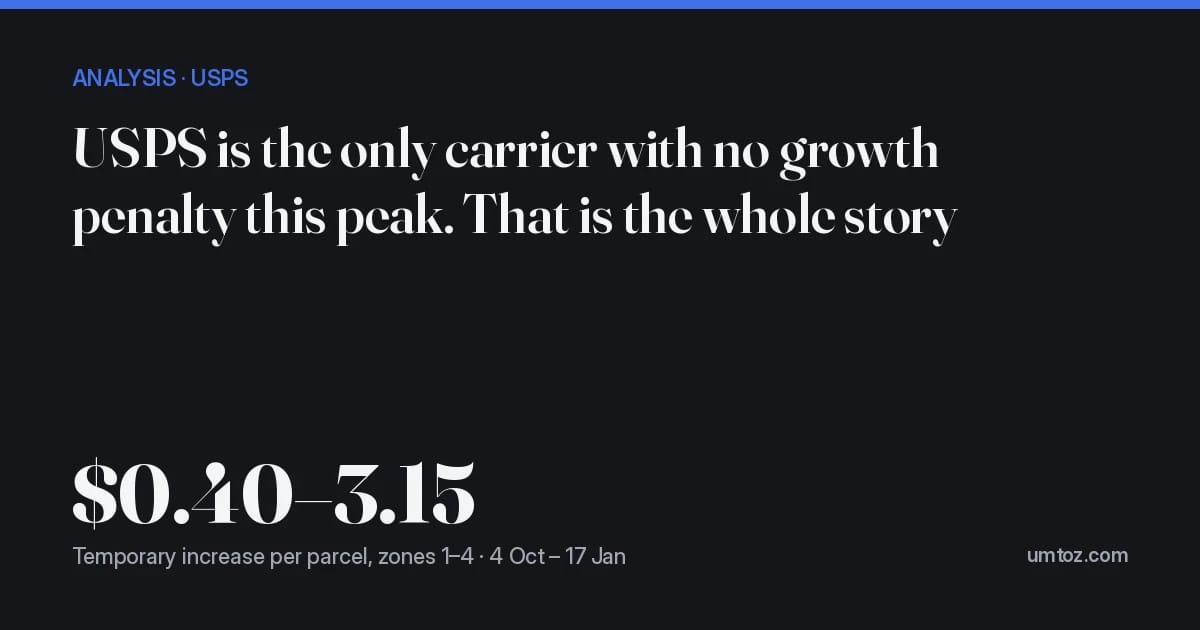
The US Postal Service filed a notice with the Postal Regulatory Commission on 25 August for what it calls a temporary price change on package products ahead of the holiday season. If approved, the new rates take effect at midnight on 4 October and run until midnight on 17 January 2027. They apply to retail and commercial domestic parcels across Ground Advantage, Priority Mail, Priority Mail Express and Parcel Select.
The increases themselves are modest by the standards of the season: roughly $0.40 to $3.15 per package in zones 1–4 depending on service and weight, with Parcel Select split into four weight tiers. This comes on top of a separate 8% transportation-related adjustment that began in April and also runs to 17 January, so the two windows overlap through the holidays.
The number that is not in the filing
What makes the USPS increase different is what it lacks. UPS and FedEx both index their peak demand surcharges to volume. UPS moves any customer billed for more than 20,000 qualifying packages in a week to a higher-volume table and keeps them there "until further notice", which for some shippers means a single heavy week last November already set their pricing for this December. FedEx recalculates every week against a June baseline, so a brand running at twice its summer volume pays several times the standard peak rate per ground package.
USPS has no such mechanism. The increase is the same per parcel whether you ship a hundred orders or a hundred thousand. For a fast-growing brand, or one running a promotion that spikes volume, that is not a minor detail. It is the difference between a known cost and a variable one that punishes success.
The financial backdrop
The filing lands in an improving quarter. In fiscal Q3 (April to June) USPS reported operating revenue of $19.94 billion, up 6.1% year on year, which it attributed to growth in Ground Advantage. Volume was 25.43 billion pieces, up 0.4%. The controllable loss narrowed to about $1.0 billion from $1.6 billion in the prior-year quarter. Postmaster General David Steiner described it as progress in "revenue generation, cost control and service improvement".
Ground Advantage is the product that matters here. It is the lightweight, zone-priced service that took the place of First-Class Package and Parcel Select Ground, and it is where USPS competes head-on with the integrators' ground residential products — the same products carrying the steepest peak surcharges.
What to do with this
Model the split. Take last Q4's volume by service and weight band. Anything under a pound going residential is a candidate for Ground Advantage during the peak windows. Run it against your UPS or FedEx demand table at your actual volume tier, not the published base rate.
Check the threshold you may already have crossed. If UPS billed you for more than 20,000 qualifying packages in any week since late 2025, you are on the higher-volume table now. USPS overflow is one of the few ways to keep your integrator weekly count below the line.
Watch the PRC. The rates are filed, not yet approved. Approval has been routine for temporary peak pricing in previous years, but the effective date is contingent on it.
USPS is not the cheapest carrier for every parcel, and its service reliability outside metro areas is still the reason shippers hesitate. But this peak it is the only one of the three that will not charge you more for growing.
Sources
- Digital Commerce 360 , September 1, 2026 (digitalcommerce360.com)
- Shippo , August 25, 2026 (goshippo.com)
- 3PL Center , September 2, 2026 (3plcenter.com)
Reported and summarised by umtoz.com. Links go to the original publishers.