Amazon Supply Chain Services, four months in: the threat is structural, the evidence is still thin
In May Amazon opened its freight, fulfilment and parcel network to any business and knocked 9–13% off FedEx, UPS and GXO in a day. Since then: a seller conference, a peak surcharge and very little public data. What to watch.

On 4 May Amazon announced Amazon Supply Chain Services: its freight, distribution, fulfilment and parcel network, bundled and sold to any business, whether or not it sells on Amazon. Launch customers were Procter & Gamble (raw materials to plants via Amazon freight), 3M (factory to distribution centres), Lands' End (a single inventory pool fulfilling every channel) and American Eagle Outfitters (Amazon parcel for its own website orders).
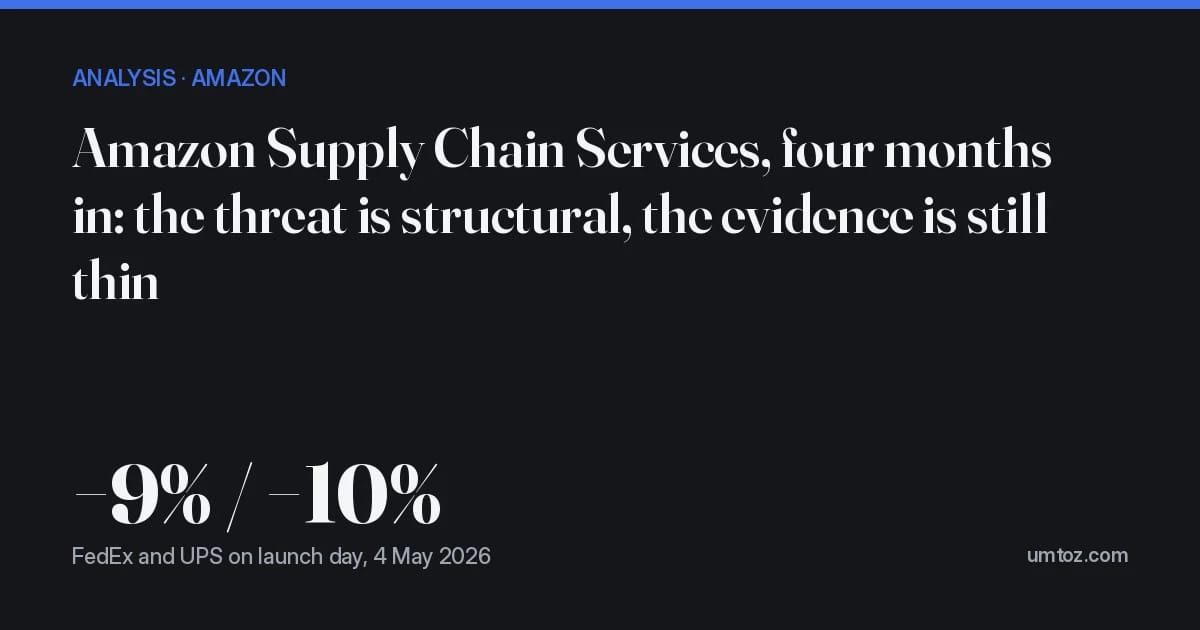
The market treated it as a watershed. FedEx fell 9.1% that day, its worst session in over a year; UPS lost more than 10%; GXO dropped close to 13% and DHL 7.3%. Evercore called it "a direct competitive blow". Four months later it is worth separating what was real about that reaction from what was reflex.
What was real
The scale is not hypothetical. Amazon runs more than 200 US fulfilment centres, over 80,000 trailers, 24,000 intermodal containers and around 100 aircraft — the third-largest cargo fleet in the country behind FedEx and UPS. It delivered roughly 13 billion items last year. By Pitney Bowes' count it was already the second-largest US parcel carrier by volume in 2024, behind only USPS, and is on track to be first by 2028.
The commercial logic is also real. Amazon is not building capacity for this; it is monetising capacity it already has, the way AWS monetised spare compute. Its target is not the consumer parcel market, which it dominates anyway, but B2B freight and distribution — denser, more predictable, higher-margin, and the segment where UPS and FedEx have been retreating to protect yield. Every pallet P&G moves on an Amazon truck is a pallet a contract carrier did not move.
What was reflex
Nobody outside Amazon has seen a price list. Amazon said costs "will vary based on the services businesses use", which is a sentence, not a rate card. The four launch customers were announced; no further large enterprise names have been made public since. The Q2 earnings call in late July did not break out ASCS revenue. In September the company is running Amazon Accelerate, its seller conference, from 22 to 24 September in Seattle, which is the most likely venue for a second wave of announcements. Until then the evidence for traction is the launch press release.
There are also structural limits that the sell-off ignored. Data. GXO's chief executive made the point publicly within days: enterprise customers are reluctant to give Amazon visibility into their supply chain when Amazon competes with many of them at retail. A consumer-goods company handing its inbound freight flows to a company that also sells private-label versions of its products is not a small ask. Scope. ASCS excludes hazardous materials, several battery categories and goods needing special handling, which removes a large share of industrial and automotive freight from the addressable market. Importer of record. Amazon can move goods across borders, but it cannot be the legal importer in 170 jurisdictions; that remains the customer's problem.
Who should actually be worried
Not FedEx and UPS in the first instance — their exposure is the B2C parcel business they were already losing to Amazon's own fleet, and both have spent two years deliberately shrinking Amazon volume. UPS cut its Amazon packages by more than half; FedEx came back in only for bulky residential.
The exposed parties are the contract logistics and 3PL layer: GXO, DHL Supply Chain, Maersk Logistics and every mid-sized fulfilment provider whose pitch is multi-channel inventory pooling. That is exactly what Lands' End signed up for. A brand that can hold one stock position in Amazon's network and serve its own site, wholesale and marketplaces from it has less reason to pay a 3PL for the same thing.
What to watch
Whether a second cohort of enterprise customers appears at Accelerate. Whether Amazon publishes any pricing or SLA framework. Whether the 15 October peak fulfilment surcharge, which applies to sellers, is extended to ASCS customers too — the first test of whether "any business" is treated like a customer or like a seller. And whether GXO and DHL's next earnings mention lost bids to Amazon.
The May sell-off priced in a competitor that had arrived. What arrived was an announcement. The competitor is still being assembled, and the next four months will say more than the last four did.
Sources
- Amazon , May 4, 2026 (aboutamazon.com)
- GeekWire , May 4, 2026 (geekwire.com)
- Reuters via Investing.com , May 5, 2026 (investing.com)
- Carra Globe , May 8, 2026 (carraglobe.com)
Reported and summarised by umtoz.com. Links go to the original publishers.