One year without de minimis: what a Turkish D2C brand now pays to ship to the US
The $800 duty-free threshold has been gone for a year and is now written into regulation and statute. A plain reading of where the rules stand, and what they mean for a small exporter shipping direct to American customers.

For most of the last decade the single most valuable line in US customs law for a small exporter was Section 321: any shipment worth $800 or less entered duty-free, with no formal entry and almost no data. In fiscal 2024, 1.36 billion parcels used it. A year ago, on 29 August 2025, it stopped applying to commercial shipments from anywhere. Enough time has passed to say what actually replaced it.
The rule is no longer an executive order
The suspension began as executive action — China and Hong Kong in May 2025, everyone else that August. Two things since then have made it permanent in all but name.
In February, after the Supreme Court ruling on IEEPA tariffs, a new executive order continued the de minimis suspension explicitly, so the court decision did not restore the exemption. In June, CBP published interim final rules that wrote the suspension into 19 CFR 10.151. And separately, the reconciliation law enacted in July 2025 repealed Section 321 for all commercial shipments by statute, effective 1 July 2027. Whatever happens to the tariffs themselves, the duty-free parcel is not coming back.
CBP says it collected over $1 billion in duties on 246 million low-value shipments between May and December 2025 alone.
The tariff on top changed on 24 July
The de minimis question is whether you pay duty. The separate question of how much changed again this summer, and it matters more for a Turkish shipper than for most.
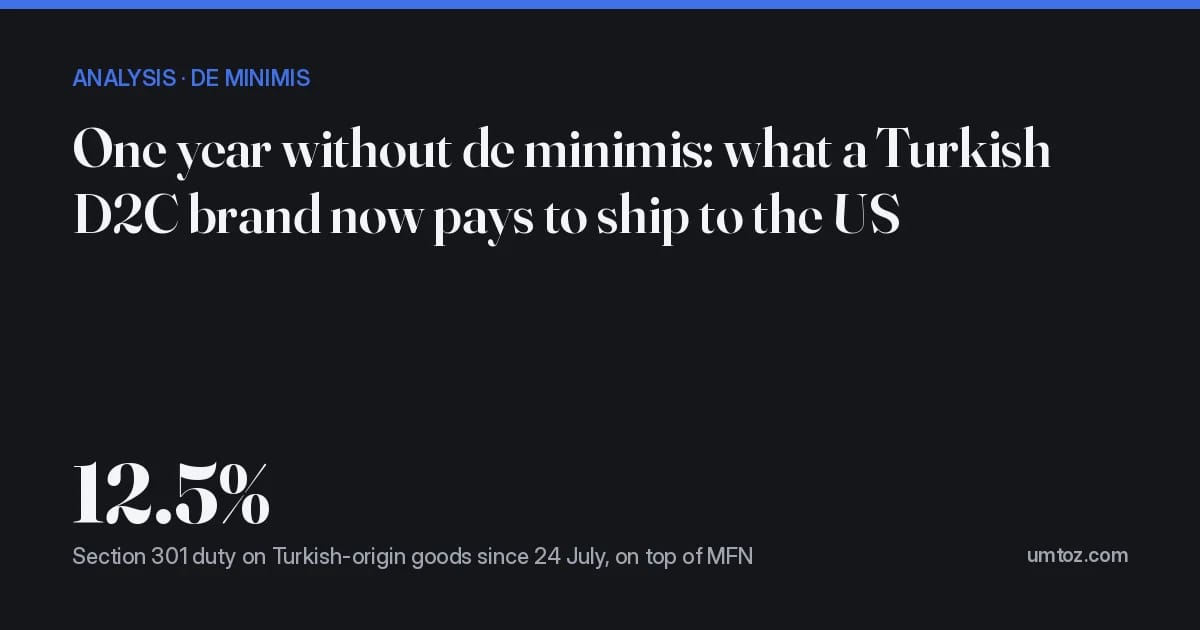
The 10% global surcharge imposed under Section 122 of the Trade Act after the Supreme Court ruling had a 150-day statutory life. It expired at 12:01 a.m. on 24 July, and Congress did not extend it. At the same minute, USTR's Section 301 action on forced-labour import bans took effect: an additional 10% or 12.5% on products of 60 economies covering 99.4% of US imports, stacked on top of the normal MFN rate.
Türkiye is in the 12.5% tier. It has no forced-labour import prohibition on its books and no reciprocal trade agreement committing it to one, so it was placed with the 38 economies that pay the flat rate. That is a 2.5-point increase on the Section 122 surcharge it replaced, and it is not a temporary measure with a sunset date.
The comparison that should bother a Turkish brand is the European Union. EU-origin goods are capped at 10% including MFN: if a product's normal rate is already 10% or higher, the Section 301 addition is zero. A Turkish leather bag and an Italian one, competing for the same American customer, now carry very different duty on arrival.
Section 232 goods — steel, aluminium, copper and their derivatives, autos and parts — are outside the 301 action and keep their own rates.
What a Turkish exporter now pays
Take a brand in Istanbul selling a €60 handmade leather bag to a customer in Chicago, shipped direct.
Duty. The bag is classified under its ten-digit HTSUS code, pays the MFN rate for that heading — roughly 9% for a leather handbag — plus the 12.5% Section 301 duty for Turkish origin. Call it 21.5%, or about €13 on a €60 bag, before fees. Origin is what matters, not where the parcel was posted from.
Entry. If the parcel goes by express carrier, the carrier files an informal entry and bills the duty plus a brokerage fee, typically to the recipient unless you ship DDP. If it goes by post, it falls under the postal informal entry process that started on 24 July, which requires a customs bond and a full data set, and from 22 September can be filed electronically as Entry Type 13. The postal DDP ceiling rose from $800 to $2,500 at the same time.
Data. Country of origin, HTSUS, value and a real product description on every parcel. Undervaluation is now an enforcement target, not a grey area.
The result is that a €60 bag carries €13 of duty and typically another €10–15 of carrier brokerage and disbursement fees on arrival. Shipped DDU, the customer discovers that at the door. Shipped DDP, you discover it in your margin.
The three ways exporters have adapted
Absorb and reprice. Works for high-margin goods where the duty is a few points. At 21.5% it does not work for anything competing on price.
Move stock into the US. Ship in bulk, pay duty once on the replenishment shipment, fulfil domestically. This is what Shein and Temu did, and it is what most 3PLs report as their fastest-growing request since last autumn. It requires inventory capital and a US partner, but it also removes the customer-facing surprise and cuts delivery time from ten days to two. It does not reduce the duty rate — the 12.5% applies to the pallet as much as to the parcel — but it removes the per-parcel fees, which for a €60 item are the larger number.
Change origin. Only relevant where a product can genuinely be made elsewhere; substantial-transformation rules are policed, and mislabelling origin is fraud, not optimisation. The EU cap makes this more tempting than it was in June. It is also exactly where CBP is looking.
What to actually take from this
De minimis was a subsidy for direct-ship models, and it is gone. The exporters doing well a year on are not the ones who found a workaround but the ones who accepted that the US now behaves like any other market with a real customs border: you land inventory, you pay duty on it, and you compete on product and service rather than on a threshold. For a Turkish brand, the bulk-ship-and-fulfil-locally model is the same one it would use for Germany. The US has simply stopped being the exception — and since July, it is a more expensive one than it is for a German competitor.
Sources
- Congressional Research Service , August 7, 2026 (congress.gov)
- USTR , July 23, 2026 (ustr.gov)
- Dünya , July 24, 2026 (dunya.com)
- Carra Globe , July 28, 2026 (carraglobe.com)
- Zonos , September 8, 2026 (zonos.com)
Reported and summarised by umtoz.com. Links go to the original publishers.